It's not salt, it's adventure!
OBX Expedition - April 22-27, 2025
1. Loading Up
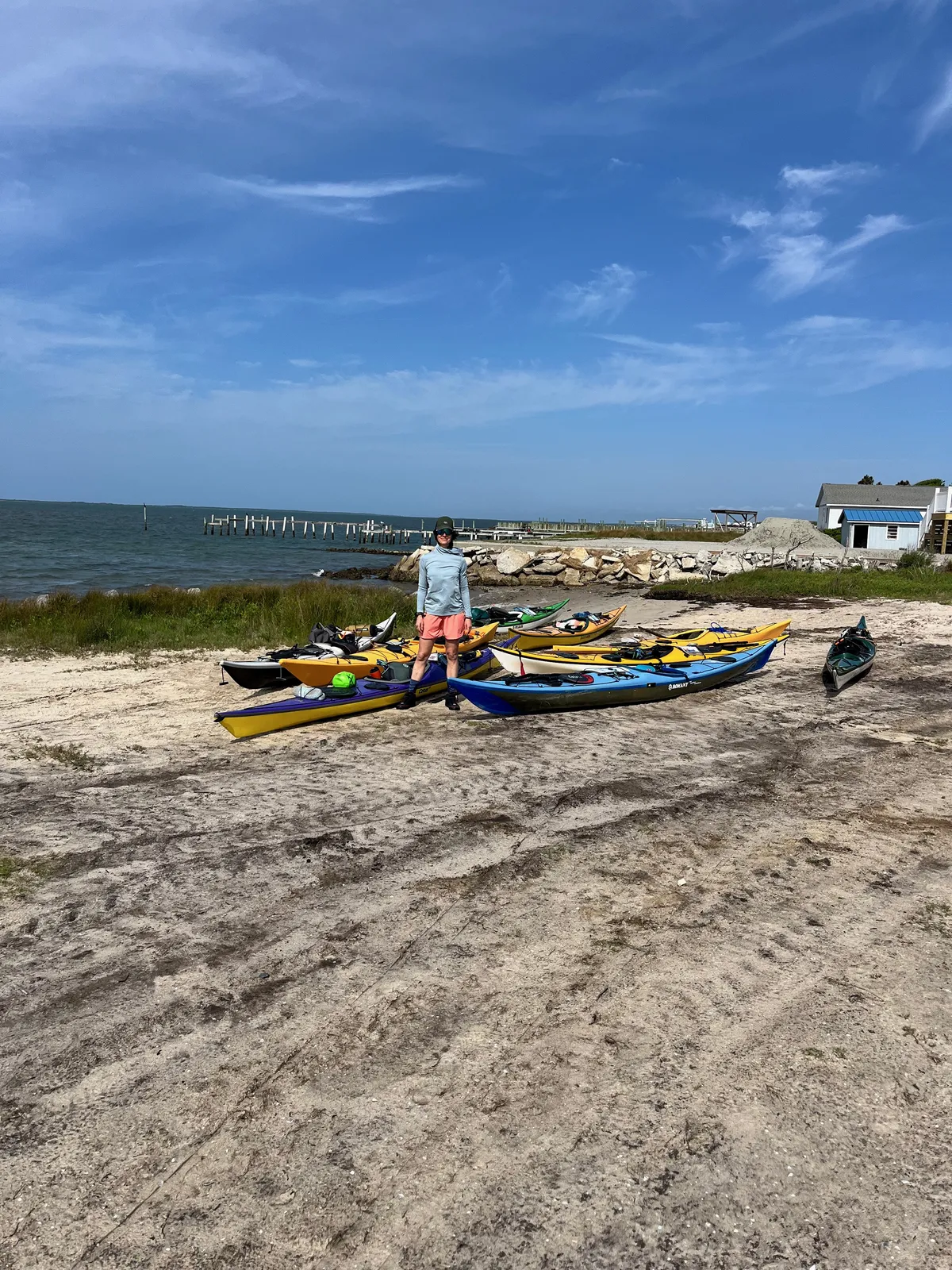
On Tuesday morning, our boats were lying on the grass at Shell Point, on Harkers Island. With mild concern, I looked at the two Ikea blue bags I had used to “measure” what my Cetus could carry, full to the brim with dry bags and other loose items - tent stakes, stove, water bottles.
I had numbered all my dry bags and catalogued their content in the hopes I would know what was where. Bags #2 and #4 had my dry clothes and my spare dry clothes; #8 toiletries and the famous “shower wipes” that I hoped could replace a shower. #13 held my sleeping bag, and so on.
As I started pushing the bags into the hatches, I soon realized that several were too bulky to fit in my low volume boat. Feeling slightly overwhelmed, I started opening the larger bags and reassigning their content; pretty soon, items listed in bag #5 were now in #3, and items previously in #3 had been tossed in a pile destined to remain in the car… making my legend nearly useless. Jeff generously offered to carry one of my water reservoirs, as well as my fresh fruit bag and a pouch of spring mix salad (which somehow survived for the next three days). Now I understood why Jake had tried at least 3 loading iterations in preparation for the trip, and felt slightly annoyed at myself for having underestimated the complexity of the task at hand.
I was not the only one to find the operation challenging. “Packing for 5 days with everything you need into a kayak was a Tetris dream”, recalls Marilyn.
Or a nightmare, depending on your tolerance for puzzles, and for chaos.
2. Like seas, like mountains
When Jeff had mentioned the trip, a month earlier, I had decided to join the expedition on a whim, taking advantage of a shift in the dates of a work project. I had never kayak-camped, and I thought the Outer Banks would be the perfect opportunity to lay the foundation for future, more complex expeditions. Jeff’s enthusiasm had quickly dissipated any hesitation. “Expeditions are my favorite thing about kayaking,” he told me. “I love traveling by kayak and visiting places you can't easily access by road, or power boat.” The prospect of the trip had conjured in my head the solitary beauty of the ocean at sunset, and falling asleep to the sound of the waves crashing onto shore.
The desire to learn how to manage the complexities of a kayak camping trip in a somewhat remote and pristine environment was a shared motivation within our group. “I really enjoy the challenge of being self-sufficient and having to deal with what happens during the trip,” explains Dean. But many of us knew each other, and had also signed up for the very opportunity to paddle with friends, and with Jeff and James.
“I saw this trip as another opportunity to learn from two highly regarded kayak leaders and guides, to learn about the region and its history and to learn more about expeditioning, the good, the bad, and the ugly!,” says Ricardo.
To me, the Outer Banks expedition promised the kind of adventure I had always associated with mountaineering. And so, I wasn’t surprised to learn that James, who led the trip with Jeff, was indeed a mountain climber. “How do expeditions on the water compare to those in the mountains?” I asked him.
“There are no bugs in the mountains,” he responded. “And of course, the gear is different, as well as personal skills. But the expedition part is much the same. Navigation and route finding, recognizing the hazards, and paying attention all work the same way, regardless of location. Situational awareness is the key to safety in both sports. And both sports have the challenge of the winds. This past trip to the mountains we were up at midnight during a 50-mph blizzard tying down the tent and building a snow windbreak. A huge difference in the two sports is that on the ocean our gear floats, in the mountains we carry it on our back! Scenery in both environments is spectacular!”
3. The wind - Part 1
The wind would turn out to be, indeed, a challenge. Starting on the very first day. When we finally launched from Shell Point, on Tuesday April 23, we were behind schedule on the first leg of our trip to Cape Hook, a “short” 4 mile crossing of the sound.
Leaving almost 2 hours later than planned caused the tides and current to be harder”, says Marilyn. “If we could have gotten on the water sooner that first day,” adds Bev, "the wind and the tide would have been in our favor. But it took us a long time to pack the boats, drive the cars to another location, etc.”
James agrees that the first day was the most challenging. “The timing of the tide and the building winds were insisting on an early launch. But our shuttle, organizing our gear, loading boats took a long time. Consequently, we paddled out to Cape Lookout against the current and the wind, long trip.”
In addition to wind and current, several people experienced boat issues as we made our way towards Cape Hook, seeking shelter from the crosswind in the shallow water along the sandbars. My boat was sluggish, and I felt like a small scale version of the freighters I see on the Detroit River, but I didn’t have any real problems. However Bev, James’ partner on water and on snow (and in life), contended with a kayak made unwieldy by the weight of the water she needed to carry for health reasons (she ditched it on Day 3). Ricardo’s back hatch, we soon discovered, was shipping water, making it hard for him to control the boat in the strong wind. “My cockpit was mysteriously filling with water during the crossing and I thought it was due to my neoprene sprayskirt. When I landed and opened the stern hatch, I realized it was full of water.”
“Ricardo was clearly tired and struggling with what later became clear was a rear hatch full of water,” recalls Kathryn, “and he asked that we rest on the bar [at Shakleford banks] for longer before the crossing. Dean and I had kept him company in the back for most of the trip, and towed him the last mile, to just before the crossing.”
3. The crossing
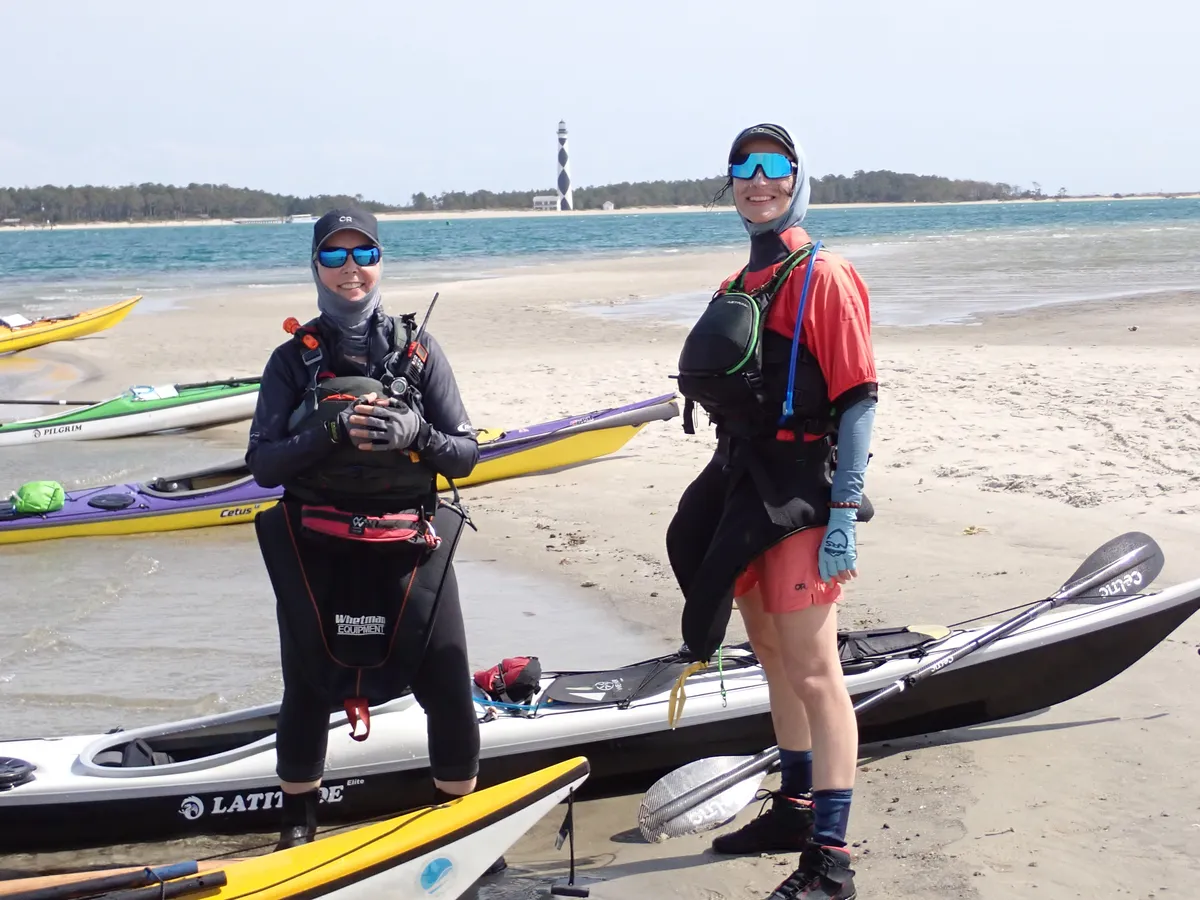
The plan was to “cross as a group” from the tip of Shakleford Banks to Cape Lookout, across the shipping channel. Mindful of Rick’s boat issues, Jeff wanted to keep following Shakleford’s shoreline south as long as possible, to minimize the impact of the wind and current, and then cross with a high ferry angle to prevent the current from pushing us past our desired course.
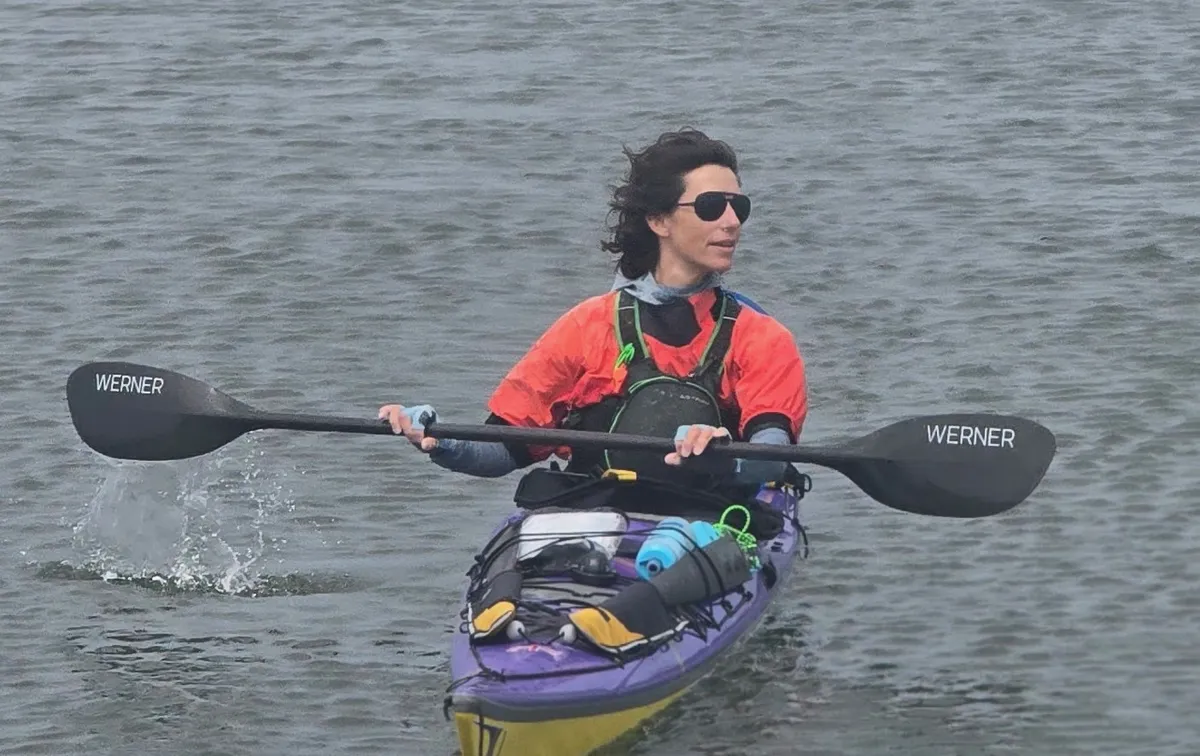
But things didn’t quite work that way, and we quickly found ourselves split in two. James, Bev, Marilyn, Dean, and Kat started moving towards the middle of the channel, while the remaining four of us were still advancing close to the shoreline. Jeff waived at James’ group to keep going, and said we would hug the bank a little longer to make the crossing easier for Ricardo. The plan didn’t work too well for Rick, whose Greenland paddle made it challenging to stay in shallow water and to power through the current. (I had ditched the stick at our last stop, in favor of my Werner.)
Jeff dropped back to switch paddles with him. Assuming we’d regroup before crossing, I followed Jeff, but he and Ricardo had already moved towards the middle of the channel before I could even get there. Jake had started crossing on his own from our earlier position.
Wondering what had happened to the “cross as a group” part, and slightIy frazzled by finding myself unexpectedly separated from others, in the howling wind, I resolved to
stick to my group’s plan. I felt somewhat on edge because I knew that it would have been better not to cross alone, but I didn’t want to waste energy by trying to catch the group downstream of me; and trying to communicate at a distance, over the noise of wind and waves, only made the situation more stressful. To regain focus, I turned my attention to paddling and set my ferry angle, aiming higher than our intended take out point. A few minutes later I reached the shore as planned, and left myself drift downstream for a few hundred yards to get to the takeout.
“We could have maybe used more of a plan for “what if” the group divided during the crossing,” comments Kat. Her and I discussed what had happened as soon as we regrouped on Cape Lookout, and it took us some time to reconcile her concern for safety with my decision to stick to a known plan. Reflecting on the crossing, Jeff said: "It was not my finest moment as a leader. While I knew everyone would be okay, it was not as tightly organized as I wanted it to be in the event that something did go wrong.”
“Conditions did not allow for good communication,” says Marilyn, “and people did the best they could to paddle.”
The “short” 4 miles from Shell Point to Cape Lookout took a toll on the group and probably shaped the subsequent decisions some of us made. “The first day's crossing was brutal!” Says Ricardo. “It was a four-mile crossing that took more than four hours to complete.” Marylin echoes the sentiment, explaining that the first day’s crossing is some of the hardest paddling she’s done to date.
4. The sand dunes
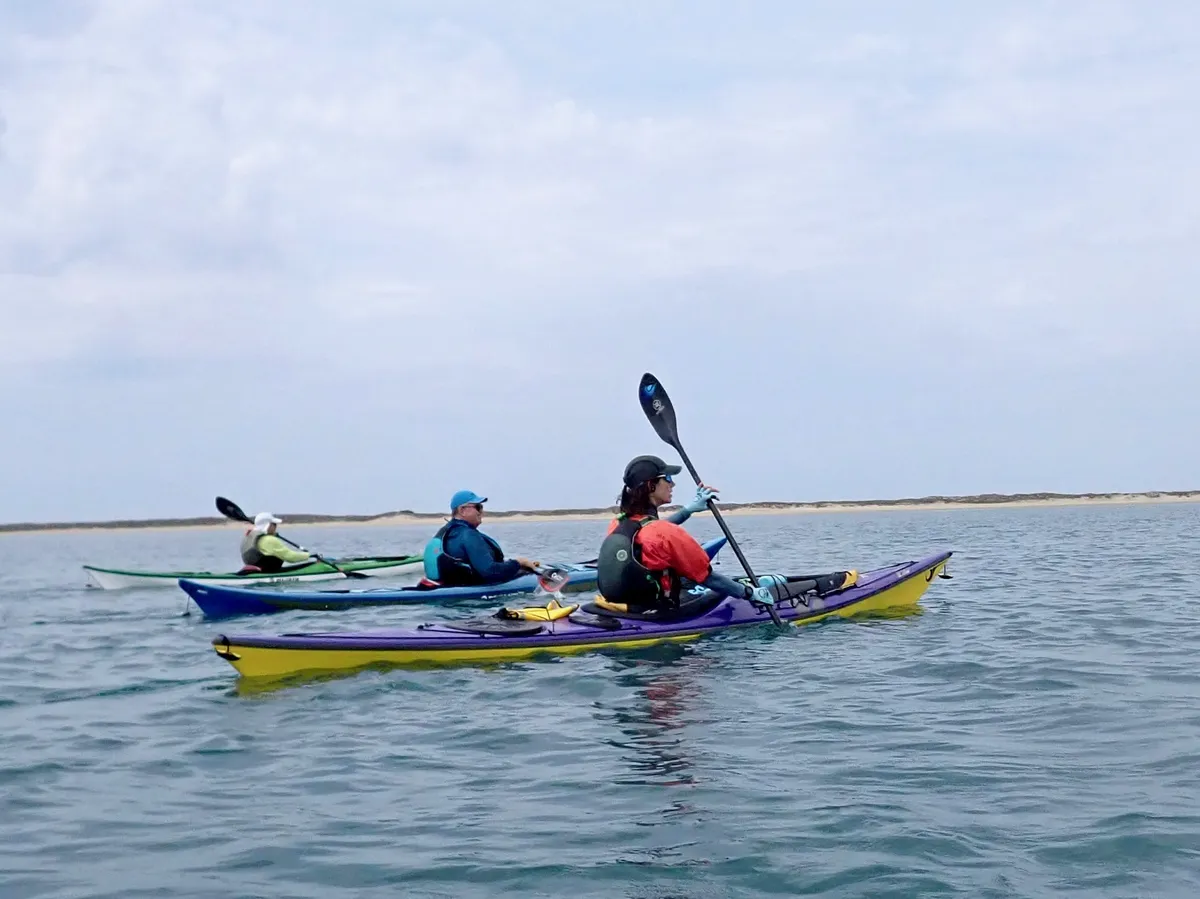
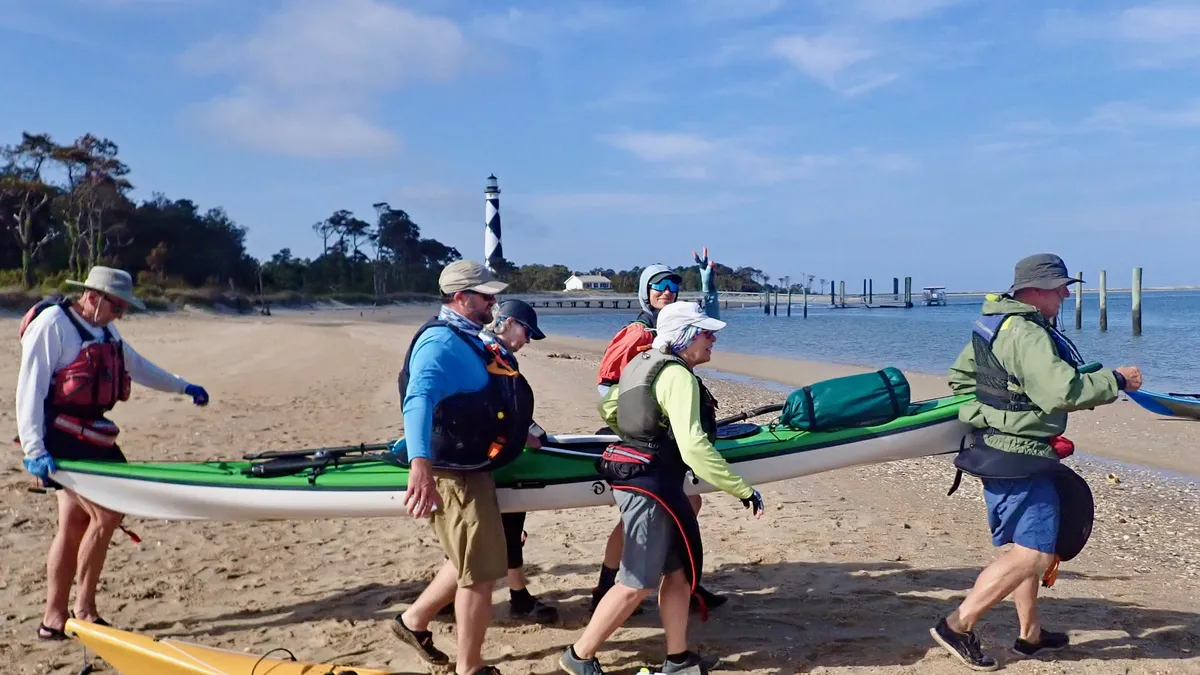
When I had imagined sunsets and sunrises overlooking the ocean, I had not fully realized what camping on the beach would entail. After landing, we’d have to find and collect the gear jammed in the boats - tent, stove, sleeping bag, food, dry clothes - then move the boats off the beach, and finally walk to the other side of the bank. Even partially unloaded, our boats were so heavy that they required at least 4 people to move each one of them, but ideally 6.
Once the boats were stowed out of the way, we’d have to carry our gear-loaded Ikea bags to the beach on the ocean side of the bank, and set up camp. The logistics turned out to be way more taxing than many of us had imagined, especially on Day 1, when the group’s morale had already taken a hit due to the difficult conditions on the water. “I didn’t expect to set up camp so far from our boats,” says Kat, “but I understand why we did so, for reasons of bugs and beauty.”
“The biggest challenge for me was carrying the gear to the beach at Cape Lookout,” agrees Dean. “Are we there yet??!!”
James and Bev adopted a clever relay system, starting with two bags each, then dropping one along the way, continuing with the other, and coming back to retrieve the one left behind. Still, “all that gear properly loaded in my boat and then each day moving it to our beach campsite was difficult,” recalls James.
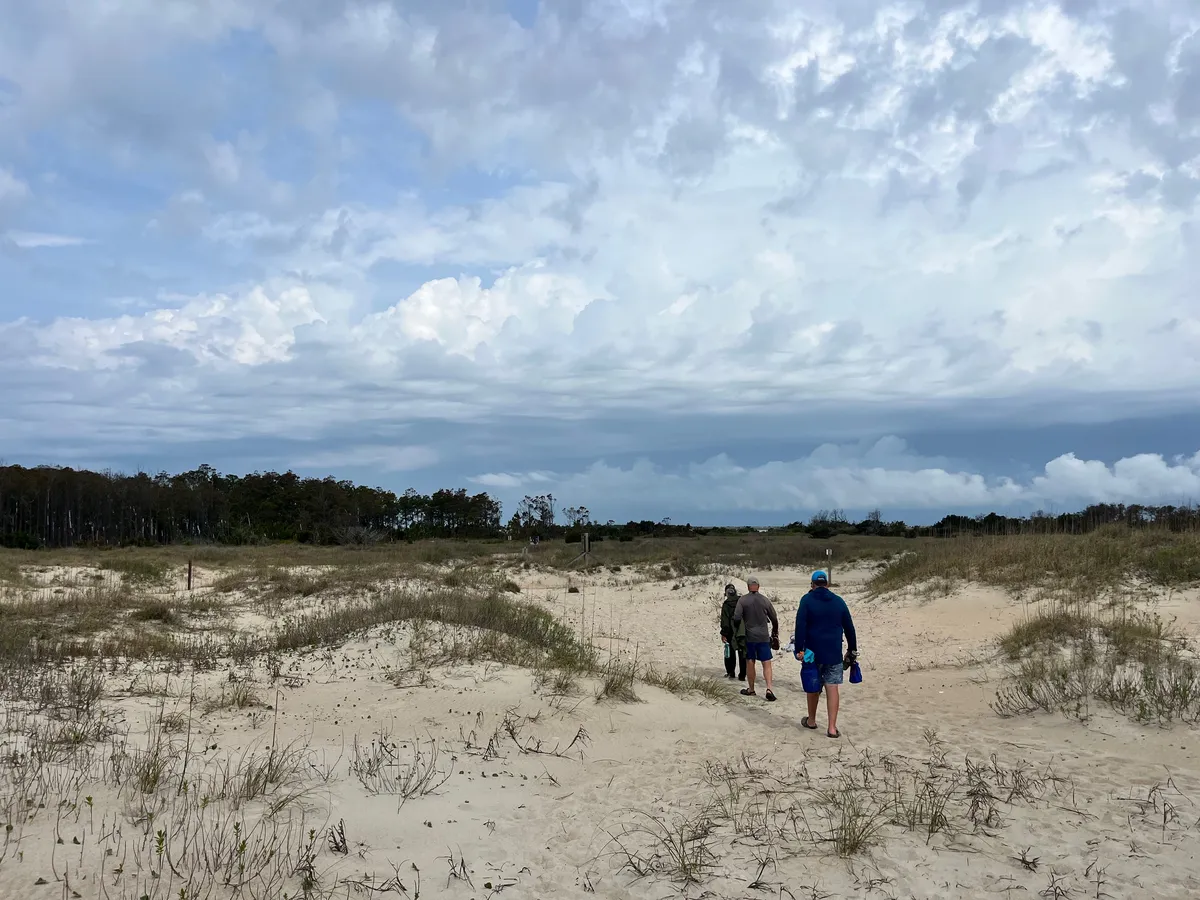
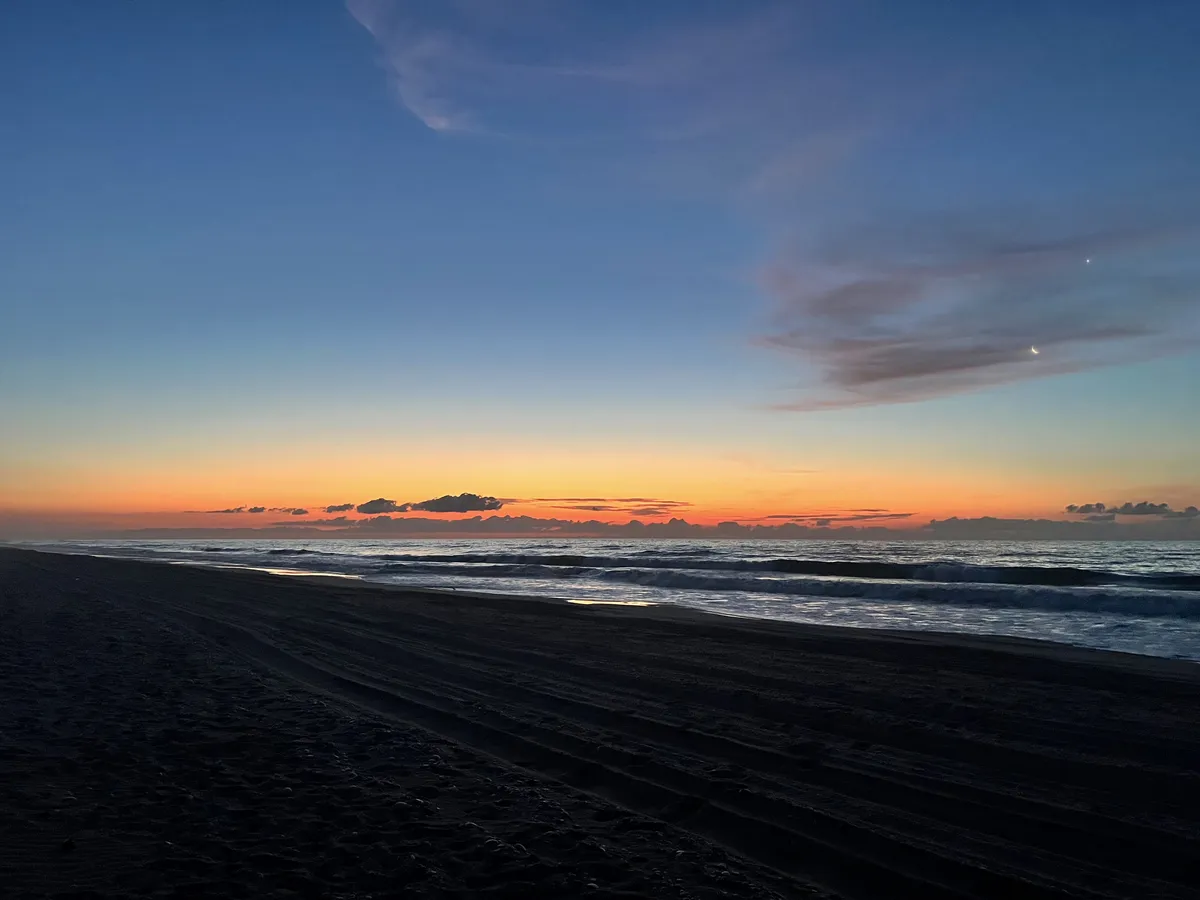
The rewards, however, were worth it. The wind on the Atlantic side attenuated the bugs’ ferocity (and, I was told, they weren’t even that bad yet!), and the sound of the ocean would lull us to sleep. I was surprised at how easily I fell into a very different schedule than the one I keep at home, falling asleep around 9:30-10pm, and waking up at 5am to start packing, while my coffee brewed. By 6am or so, the red and purple streaks of dawn started cracking the darkness of the early hours.
“My most memorable moments would be waking up to the sound of the waves hitting the beach,” recalls Dean, “and watching the sunrise over the ocean.”
5. Goodbies
As we prepared to leave Cape Hook on the morning of our 3rd day, Ricardo and Kat surprised us by saying they were considering bailing out. Spending two nights without having to break up camp had not been enough to solve all the issues that had popped up on out first day. Jeff had repaired the only visible leak he could find on Ricardo’s boat, but Ricardo was concerned that, once loaded, the kayak would continue to ship water. “I went back,” he explains, “because my kayak was not sea-worthy, especially with loaded hatches. As there were 40+ miles left to complete the journey to Ocracoke Island, I did not want to be a liability or negatively impact the expedition experience for the other paddlers if my issues continued.” Nonetheless, he says that the decision to fold was still challenging.
Kat felt “terminally disorganized”, and worried that her light tent would not withstand harsher weather or storms like we had on Day 2. She recalls waking up on the second day with no clothes to put on, except her sandy and wet neoprene booties and an oversized bug shirt.
The bag with her change of clothes had been lost somewhere the previous night on the hike to camp.
But above all, she explains, “the 1/3 mile (I measured!) of deep sand we slogged through between boats and the first camp was doing a number on my knee and I was really feeling it overnight the second night. Since I was heading overseas just two weeks later for a month-long hiking/kayaking trip, that was a huge concern.”
Kat discussed the options with Jeff, and despite the “murky” logistics of baling out further on, she thought she would continue for at least another day. “I thought I’d take it day by day…but the decision became easy and fast when Ricardo learned I was possibly leaving and said he wanted to go too, THAT DAY.”
It was decided that James and I would accompany them back, while Jeff would lead the rest of the team north towards Great Island, following the original plan. We’d reunite at “some point” along the way.
7. The bog
“I knew that the Sound was shallow near Core Banks but it was much shallower than I expected,” says James. “The shallow water had a big effect on our heavily loaded boats, making paddling much less efficient.”
Choosing to paddle in more than 4 feet of water for efficiency’s sake was easier said than done. With the exception of Day 4, on every other day we contended with competing needs: having enough water to launch and land, yet avoiding exposure to the brunt of the wind and of the current; avoid slogging in the marshes, and getting close enough to short to find our takeout spot.
The impact of water depth on paddling efficiency was manifest on the third day, when James and I cut diagonally across the sound to intercept Jeff’s group. We kept a steady pace, but we still assumed we’d be playing catch up. However, roughly 2 hours after departing Harkers’ Island, we heard some faint calls from behind us, and we were quite surprised to realize that the other group had been trailing us for a bit, trying to catch our attention. To shelter from the current and the wind, they had been wandering through the marshes which extended for some hundred meters past the shoreline.
As we continued on, we agreed to move away from the shallow water, but we could not really avoid the shoals once we entered Great Island Bay, looking for our takeout spot. We even had to get out of the boat and walk our kayaks on a leash - which didn’t feel too bad after hours of sitting, but it certainly wasn’t as efficient as paddling. “My chart was fine for navigation,” reflects James, “but I could have better used Google Earth to find the most efficient paddling route. Especially as we approached our landings and at Drum Inlet.”
6. Animals, big and small
Longpoint, our home on the 4th night, surprised us with a treat: a fully functional bathroom, complete with hot showers. While we had had potable water at all our previous stops, we had not showered since the beginning of the trip. By that point, I was covered in insect bites, especially on the neck, and rinsing off the sand and the salt felt amazing. I had probably been too cavalier in neglecting to wear the bug shirt I had borrowed from Jeff, and now I was paying the price. I still have no idea what exactly bit me, but we had no shortage of biting flies, chiggers, and no-see-ums (sand midges) - although as the name implies, I never saw the latter.
Arthropods were one extreme of the animal spectrum we encountered; at the other end were the sharks that accompanied us - and singled out Bev - for some time during our fourth day, when we paddled from Great Island to Longpoint.
“When the shark brushed my boat I saw the big fin,” says Bev, “I tried to figure how to get them to leave me alone, (paddling faster did not work), I opted to paddle toward very shallow water. Big shark, shallow water worked. I had to get in shallower water two different times on the trip. By the way,” she jokes, “as of today one shark was 20 feet long. By the time this article is written, the shark may be 25’ long.”
Jeff supposedly saw a shark, right behind my boat - but despite my best efforts, I never saw anything, and felt slightly shortchanged.
7. The sand, or Letting it all flow.
Aside from wind, current, small bugs and big predators, the other inconvenience we had to deal with was the sand, which is known to abound on beaches and sandbars. For whatever reason, I had not really thought about the practical implications of camping on a beach, and I think I expected that I could somehow keep it out of the tent. That belief was quickly dispelled as soon as I started trying to pin the tent down and stake it, on our first night. The strong wind flapped the light fabric around like a kite. By the time I had it pitched, sand was everywhere.
Right away, my mind went back to the couple I’d met at the Hocking Hills Campground, on the way South, who’d been intent on vacuuming their tent prior to taking it down. I laughed to myself, imagining how futile it would be to use a vacuum here. Not quite futile like emptying the ocean with a spoon, but close enough.
Accepting the fact that I could not be sand-free was the only option. And when I did that, I realized that it didn’t bother me as much as I would have thought. (Or at least, dry sand didn’t. Wet sand was way more annoying.) I found it surprisingly easy to just embrace the lack of control I had on my environment, and simply deal with whatever came up. Released from the need to steer my life in any particular direction, the 15-mile daily paddling average, the lack of digital distractions, and the simplicity of our routine dissolved any stress due to the pressure and demands of the “real world.”
I wasn’t the only one to feel that way. “I was surprised how much I actually enjoyed just letting things flow,” says Marilyn. “As a person who likes to have control and everything in proper order, I just let it flow. Didn't stress over time, emails, work and most everything else. This is RARE!”
8. Tough decisions
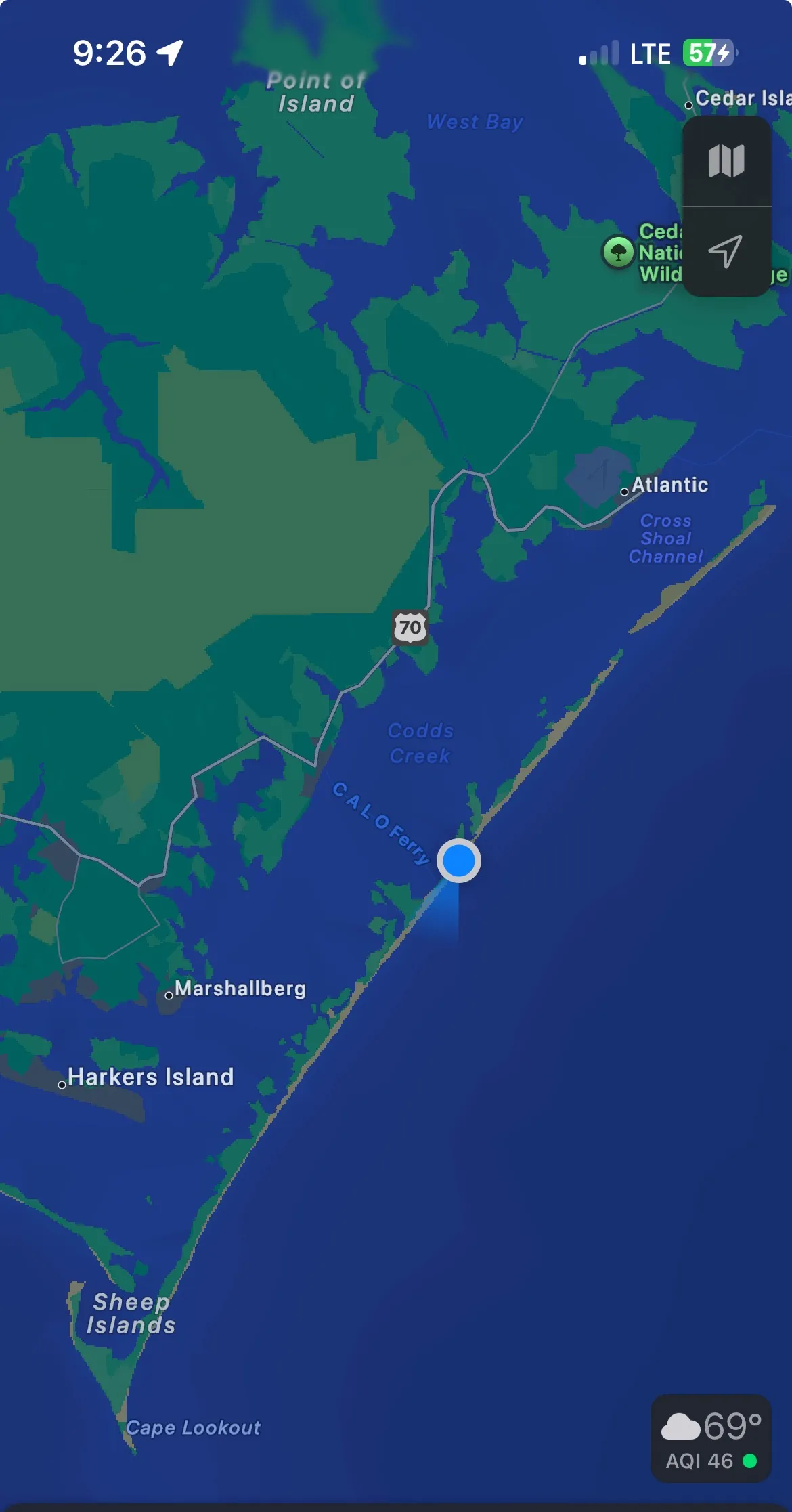
The initial plan was to complete the expedition by paddling to Portsmouth on Day 5, and on Day 6, the last day, paddle the 4 miles to Ocracoke to then take the afternoon ferry back to Cedar Island. We had also discussed paddling directly from Portsmouth to Cedar Island; this would have allowed us to wrap up our last day earlier than if we took the ferry.
However, on the morning of Day 5, Jeff announced that, for a change, the wind didn’t look good. The forecast for Sunday called for a 20-25mph headwind that would make it unreasonable to plan not only the long paddle from Portsmouth to Cedar Island, but also the shorter crossing from Portsmouth to Ocracoke. We all remembered too well how challenging the 4 miles to Cape Lookout had been, on Day 1. “The longest 4 miles ever,” as Marilyn described them. Since any paddling on Sunday was out of the picture, the only options left were to either paddle that day, Saturday, all the way to Ocracoke - a downwind 24 mile paddle - or head back to Cedar Island directly from Long point, cutting our trip short by one day.
The 24 mile paddle to Ocracoke was enticing, but another wrench in our wheel was that we did not have an accommodation booked on the very touristic Ocracoke. We soon learned that the campground closest to launch (about 2 miles) was full.The other campground was roughly 5 miles away. Additionally, there were no spots available on the early morning Sunday ferry from Ocracoke to Cedar Island. The reservation we had was for the 4 PM ferry, on Sunday. It was likely we could get on the 11am ferry, but it wasn’t guaranteed.
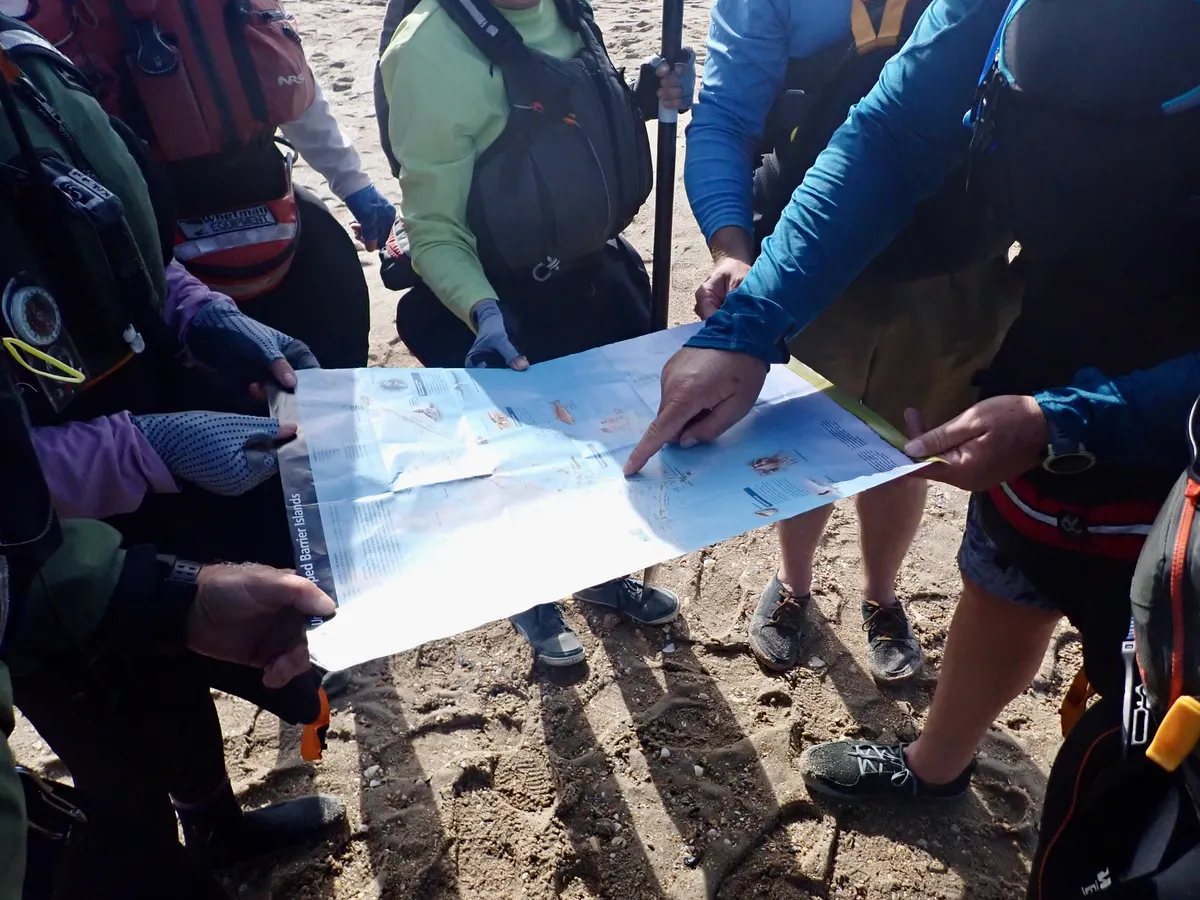
Personally, I was somewhat undecided. The 24 mile paddle had a hardcore appeal to it, but the logistics on Ocracoke were riddled with uncertainty and could cause a lot of strain to our future, tired selves. James suggested we could potentially split in two groups, if some of us wanted to continue, but we all felt pretty strongly that we should stay together. Going back to Cedar Island, we would encounter a 20-22 mph SSW beam wind, and it seemed prudent to paddle as a team.
“It was a tough decision,” recalls Dean. “I'm always learning, I think the discussions about go - no go was incredible. Processing the information we had and using that with the experience of our trip leaders was a great learning experience!”
Marilyn has no regrets, either. “The last day decision was the right call,” she says. “All week the weather forecast was wrong but proved that it is really an educated guess. Too many unknowns and cutting the trip a day early was conservative call but the right one. If I was retired I might have taken Bev's suggestion to stay on Portsmouth for a couple of days.”
For James, the moment when we all came together with a group decision was the most memorable of the trip, and I feel the same way. Sure, the downwind ride would have been fun, but after 5 days together we were all more invested in the group than in any particular paddling outcome. “I think I can say that the decisions we made were for the group and not self motivated,” comments Bev. “ It was really a great experience to see everyone come together.”
9. It’s not over, yet.
Once we set out, headed towards Back Bay, it became clear right away that we had made the right decision. The “easy” 24 mile downwind paddle would not have been easy at all for Marilyn, whose boat kept cocking in the strong wind.
She recalls dealing with the unfamiliar boat as the most challenging part of the expedition. “I normally paddle NDK boats, and the next trip will be in one of them.”
And the wind wasn’t even done with us yet. As soon as we turned the corner and started paddling northwest, I found myself stalling, almost unable to counter the powerful offshore push. I was in slightly deeper water than the rest of the group, and I had partially lowered my skeg to assist in going straight, but instead I was moving sideways, away from shore. For a moment I feared I wouldn’t be able to control my boat, and that no one would even realize I was being blown away. I was relieved when I saw James turning his head and noticing me. Once I pulled the skeg up and pointed the boat upwind, I finally managed to move closer to shore and rejoin the rest of the group.
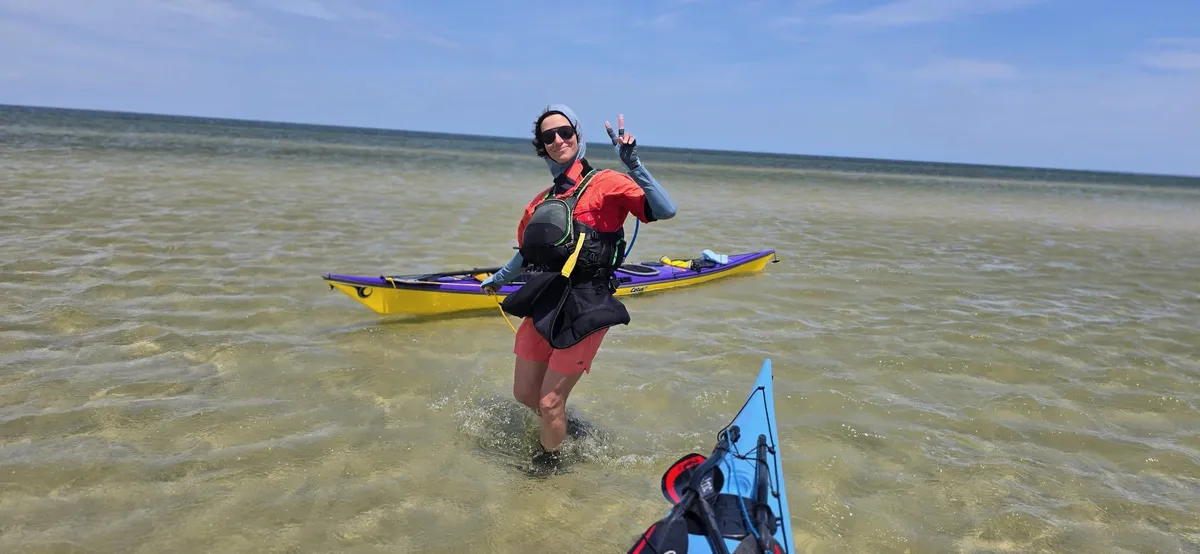
We slogged onwards in the shallow water, to take advantage of the minimal protection the land offered. The wind was brutal, but once I figured out the angle I had to keep, I had fun looking for a way to stay close to shore without getting stuck in the shoals. For the entire time, we had to keep a ferry angle to avoid being pushed downwind. It took us 2 hours and 30 minutes to cover the 5 miles to the Cedar Island ferry, often going as slow as 1.2-1.5 mph.
When the extremely shallow water made paddling too inefficient, we took a break by towing the boats. It was almost faster than paddling! That was Jeff’s most memorable moment: “Walking and pulling the boat on the last day with the wind blowing in our faces. It was a feeling of being badass for being out there and knowing we will finish. We had no choice!”
9.The end
Reflecting back on our trip, I think it fully deserved to be called an expedition. We had to adjust to changing weather conditions, deal with unforeseen issues, and tolerate a fair amount of discomfort. We had to accept the organized chaos of our daily schedules and deal as well as we could with the circumstances, recognizing that all of our decisions implied trade-offs.
“I really did not think I was going to like expedition kayak”, shares Bev. “I thought that I was too old, I couldn’t keep up, no showers for the trip, digging cat holes, maybe getting sick, big winds, maybe big currents, maybe having to bail out of the trip… but I can honestly say I LOVED expedition camping, being filthy, digging huge cat holes, paddling to exhaustion, my shark encounter and I hope there are many more
expedition camping trips in my future, especially with wonderful friends.”
As someone who doesn’t always do well in groups, what I enjoyed the most is how we were able to work together towards our common goals, and support each other with generosity and a positive attitude.
“Wow! Our team was awesome; our trip leaders are second to none”, agrees Dean. “What a fantastic group of human beings, the people I want to spend my time with. I can't say enough good things about our team!”
On the third day, I noticed that my sun shirt was stiff at the elbows with salt, and I told Jeff. “That’s not salt,” Jeff replied, “it’s adventure.”